http://www.thetimes.co.uk/tto/opinion/obituaries/article4476313.ece
Stanley Moore
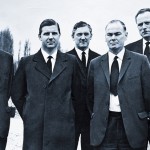
Detective Sergeant Stanley “Steve” Moore, the last survivor among the men who hunted down the “Great Train Robbers”, had no desire to quit Scotland Yard’s Flying Squad and return to the streets of Camden. The boss was clear, though; if the suspect slipped through their fingers, they would all be demoted. Moore already had one scalp to his credit as police searched for the audacious robbers who had lifted £2.6 million in used banknotes from a mail train ambushed near Lechlade in Buckinghamshire in August 1963; the young sergeant had seized a south London builder by the name of Ronald Biggs a few weeks after the robbery, setting in motion an extraordinary struggle with the British justice system that would last more than 40 years. Four months later, as Moore, part of a special investigation squad, waited in the shadows, the new target was Roy James, nicknamed “The Weasel”, a key suspect who was believed to be hiding in a mews flat in St John’s Wood, northwest London. James had disappeared shortly after the train robbery and the arrest of another suspect, Charlie Wilson; when police descended on the Goodwood race track, where James was based as a racing car driver, they were too late. He had vanished. Three months later, the police were tipped off about “The Weasel’s” hiding place. He had grown a beard and lost weight and had an escape route over the roofs in St John’s Wood. A Jaguar E-type was parked and ready for him. As police planned the raid, the man in charge of the case, Detective Chief Superintendent Tommy Butler, made it clear that, if James escaped again, Moore and his colleagues need not bother returning to the Yard. Although the yellow-painted flat seemed empty, a woman police constable in disguise who tried to deliver a parcel to the address, thought there was someone inside. Moore, who was athletic, agile and no stranger to danger, quietly climbed to the first-floor balcony window and smashed the glass. As he burst into the flat, he was just in time to see James’s legs disappear through a skylight. Moore gave chase, shouting to other officers waiting outside: “Over the roof! Over the roof!” Hearing Moore behind him, “The Weasel”, clutching a bag, leapt 30ft to the ground — into the arms of a 6ft, 18- stone detective who was a former wrestler. Moore took part in the arrest of three of the suspects in the Great Train Robbery. As well as James and Biggs, whom he formally arrested at his home in Redhill, Surrey, he was one of the officers who raided a flat in Eaton Square in Belgravia, central London, and seized John Daly, the brother-in-law of Bruce Reynolds, who was regarded as the brains behind the train robbery. Daly was still in his dressing gown, having just finished a breakfast of kippers, when the police struck. The raid was the work of a six-strong team of Flying-Squad detectives handpicked for the investigation and nicknamed the “inner sanctum” by their colleagues. They worked day and night for months to solve the crime. Stanley “Steve” Moore was born in Crediton, Devon, in 1927, the son of a tax inspector. Educated at Haberdashers’Aske’s School, Moore served with the Royal Artillery during his National Service and wanted to become a farmer. He started agricultural training but decided that buying a farm was beyond him. In 1949, he joined the Metropolitan Police. He adopted the name of Steve rather than Stanley by accident when he enrolled for police training and signed on as S Moore. Everyone assumed he was called Steve. He liked the name and kept it for the rest of his life. Moore became a detective only because he was a good rugby player. As a beat officer, he had difficulty getting time off work to play for the Met. Fellow members of the team who were CID officers had no such difficulties and advised Moore to switch. He became a detective in 1954 and joined the Flying Squad as a sergeant in 1961. He was highly rated by his superiors both for his police work and his physical bravery. Detective Inspector Frank Williams, who led the “inner sanctum” after the Great Train Robbery, said the team was made up from the best officers on the Flying Squad, and Moore was among the most able. The officers were expected to deal with the toughest criminals in the London underworld, often armed with nothing more than their wits and a truncheon. In Moore’s case, he often brought his man down with a rugby tackle and later said he only used his truncheon once. A year before the train robbery, Moore was part of a team staking out a north London bank where a robbery was expected; they sprung their trap as three men appeared, pulling scarves over their faces and drawing guns. One man fled, pursued by Moore; the robber turned and threatened to shoot but Moore kept coming. The robber jumped into a getaway car; Moore pulled the door open and struggled with the robber who pointed his gun at the policeman’s head. Moore clung on. He was eventually shaken off as the car sped away, but the robber was arrested after another struggle that evening. Moore was undaunted by the threat of being shot. He said his biggest worry was what his wife, Helen, would say when she saw the state of his clothes, particularly the fine woollen waistcoat she had spent weeks knitting for him. They were married in 1954. The couple had two children: Christopher is a telephone engineer, while Madeleine is a biochemist. They all survive him. Moore received a commissioner’s commendation for tackling the robber and had 18 commendations by the time he retired. A familiar figure giving evidence in court, Moore had a special “Old Bailey suit” which he kept for appearances in the witness box. Moore eventually joined C11, Scotland Yard’s criminal intelligence department, as a detective inspector. As a detective superintendent and then chief superintendent, he was among the founding officers of A10, a specialised anti-corruption team, set up by Sir Robert Mark, commissioner of the Metropolitan Police, in 1972. After three years he moved to the Home Office, where he liaised between the police and the Prison Service, but he remained “in contact” with the Yard. In 1975 he received information that a robbery was planned on a branch of the Bank of America. Police identified the gang, which got away with £8 million during the raid in Mayfair, but most of the men were later arrested. Moore retired in 1978 after heading the regional crime squad covering London and spent ten years working for Courtaulds as chief security officer. In retirement, he partly achieved his ambition of becoming a farmer when he devoted his time to growing fruit and vegetables — everything from figs to olives — in his large garden. When the BBC commissioned a docu-drama on the Great Train Robbery in 2013, Moore collaborated on the making of the film, and was guest of honour at the launch of the two-part programme, enabling him briefly to relive his finest hour. Stanley Moore, QPM, detective, was born on May 5, 1927. He died on June 15, 2015, aged 88
©Times